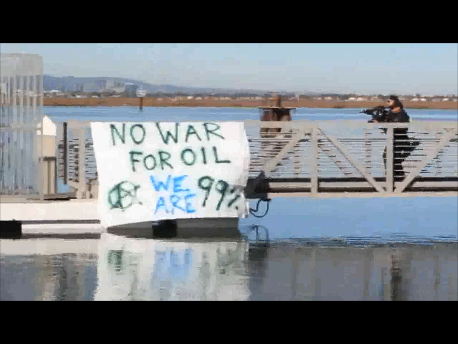
Frame from video, Urban Shield 2012 Highlights, listed on Youtube as sponsored by the Alameda County Sheriff’s Office.
by Andrew Lichterman
Urban Shield, a huge multi-agency emergency response drill, will be held at sites throughout the Bay Area from October 25-28, 2013. Although often presented to the public as useful for preparing the region to respond for everything from earthquakes and fires to school shootings, Urban Shield primarily is focused on preventing and responding to terrorist attacks. Urban Shield also features a trade show with vendors promoting products ranging from high powered weapons and surveillance equipment to protective gear for hazardous materials response teams. The trade show will take place at the Marriott, in downtown Oakland. The exercise also is a competition, with SWAT teams, hazmat teams, EMT’s and firefighters not only from the Bay Area but from around the world competing for top honors.
A coalition of groups centered in the East Bay is protesting Urban Shield. The law enforcement aspects of the exercise are emblematic of the militarization of policing that took root in the “war on drugs” and has accelerated and intensified in a post 9/11 era. Further, a trade show in downtown Oakland featuring guns and ammunition undercuts long-running efforts to stop the marketing of guns and ammunition, part of broader efforts to stem the tide of gun violence in the city through non-violent means rather than violent repression.
Urban Shield sometimes is portrayed as a general emergency response exercise, but its primary focus is anti-terrorism. There’s a consortium of agencies called the Bay Area Urban Area Security Initiative (UASI) that administers Urban Shield. At recent public hearings on Urban Shield, Oakland city officials tried to give the impression that the city’s involvement was limited to hosting the firefighting elements of the exercise, even suggesting that Alameda County, not Oakland, was the proper agency for questions or criticism concerning Urban Shield. All major Bay Area jurisdictions, however, participate in UASI governance: the UASI “Approval Authority” includes “representation from each of the three major cities of Oakland, San Francisco, and San Jose and the County of Alameda, County of Contra Costa, County of Marin, County of Monterey, County of San Francisco, County of San Mateo, County of Santa Clara and County of Sonoma.” (Bay Area Urban Area Security Initiative, The Bay Area Homeland Security Strategy 2012–2014, January 2012, p.5).
A report to that group on last year’s Urban Shield exercise stated that “[s]cenarios must contain a nexus to terrorism” to comply with the Homeland Security Exercise Evaluation Program. The Urban Area Security Initiative’s Bay Area Homeland Security Strategy 2012–2014 states that
“Threat assessment data indicates that the Bay Area is home to many international and domestic terrorist organizations, making it a prime location for potential terrorist attack.”
Despite the supposed multi-purpose nature of the event, anti-terrorism and military-style police response dominates the imagery, marketing, and substance of Urban Shield. Promotional videos put out by the Alameda County Sheriff’s office, which coordinates Urban Shield, have the kind of highly charged music and pacing normally associated with TV advertising for a football playoff game. The action in the video is dominated by explosions and heavily armed swat teams kicking down doors and engaging in simulated gun battles. Now and then a firefighter or EMT appears, dealing with the destruction one would expect in the wake of one or another scenario with a “nexus to terrorism.”
A frame from a video of highlights from Urban Shield 2012 appears to show heavily armed officers apprehending “terrorists” with banners saying “No war for oil” and “we are 99%.” (see image at top of page.) The frames just preceding show some kind of improvised explosive device. This raises disturbing questions of who our police are being trained to profile and target as terrorists. Both the anti-war and the Occupy movements have been overwhelmingly non-violent, and have involved no activity reasonably described as “terrorist.”
The trade show to be held at the downtown Oakland Marriott is more than just a side show. Exhibitors showcase an array of equipment including guns and ammunition, surveillance devices, software to organize the vast flows of information gathered by police agencies, and gear used by bomb squads, paramedics, and fire departments.
Participating vendors are invited to play an integral part in Urban Shield. Exhibitors pay up to $15,000 to sponsor the event, and those in the upper tiers get far more than a booth at the show. All but the lowest tier can attend one or more Urban Shield dinner events. Vendors who pay $4500 or more get tickets to a “VIP tour” allowing them to view at least eight of the exercise venues. Those that pay $7500 or more are entitled to a “Product Demonstration at a designated tactical scenario.” The vendor application warns that product demonstration opportunities will be filled on a first come, first served basis, and that “[t]o ensure your product is being utilized to its full potential, it is highly recommended you commit your product early during the scenario development process.” A 2012 Alameda County Sheriff’s Department presentation on that year’s Urban Shield exercise showed featured technologies and company logos in slides describing scenarios, for example, the Parrot-AR Drone for a scenario in which “[a] member of the Sovereign Citizen movement drove a truck into a government building which resulted in a partial building collapse and fire.”
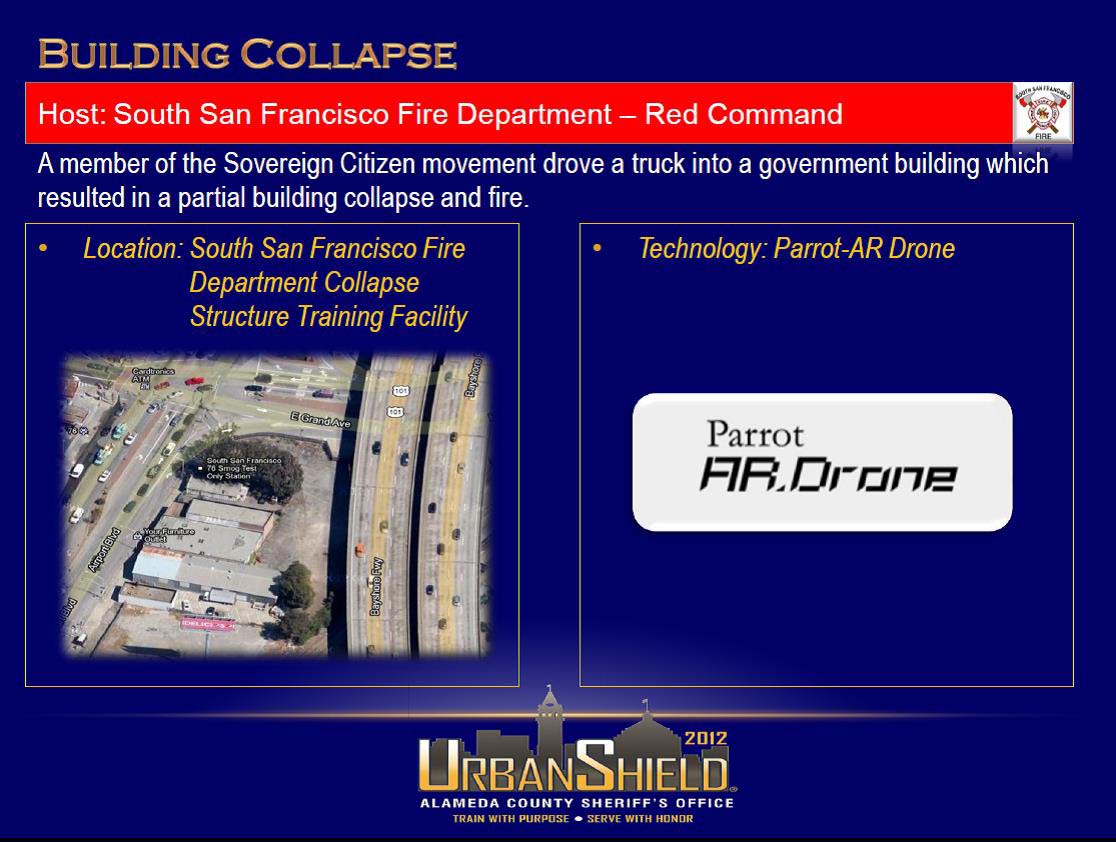
Slide from Bay Area UASI Approval Authority Urban Shield 2012 Presentation, December 2012.
We live in a society where at all levels of government money too often drives policy, and that appears to be the case with Urban Shield. In a time when budgets for public services have been under attack for years, it’s hard for local agencies to find money for emergency preparedness. Homeland Security is a big pot of money–over 50 billion dollars annually throughout the Federal government. And that’s without including Defense Department homeland security spending–another $18 billion per year. But that money comes with strings, such as the requirement that exercises like Urban Shield have a focus on terrorism rather than hazards far more likely to inflict widespread devastation on the Bay Area, such as earthquakes, floods, and fires on the wildland-urban interface. The Urban Area Security Initiative’s 2012-2014 Bay Area Homeland Security Strategy reflects the way the quest for funding shapes this inversion of priorities:
“The purpose of the Bay Area Homeland Security Strategy (Bay Area Strategy or Strategy) is to ensure the Bay Area region has a comprehensive document and system that outlines the region’s risks, capabilities, vision, structure, goals and objectives for homeland security. Having such a Strategy will ensure the Bay Area is in the best possible position to clearly track and articulate its risk and capability needs to local leaders, the State of California and the U.S. Department of Homeland Security (DHS) when seeking resources and funding to enhance homeland security and public safety across the region. The Strategy is designed primarily to address terrorism risk faced by the Bay Area with an understanding that capabilities enhanced to combat terrorism often enhance the ability to also manage natural disasters, such as earthquakes, and man-made accidents, such as hazardous materials spills.”
All of this–the acceptance by local officials, even in a supposedly “liberal” region like the Bay Area, of funding tightly tied to an increasingly militarized internal security apparatus, the incorporation of corporate marketing directly into government activities–might have seemed shocking to many a decade or two ago. The “new normal,” however, is a surveillance-internal-security state driven by an intelligence-police-prison-industrial complex, a new Homeland Security wing of the military industrial complex. As I wrote six years ago regarding Bush-era domestic spying, the Cold War arms race was fueled in large part by power and profit interests having little to do with the common good, exploiting the climate of fear and to sell an endless and ever more sophisticated and expensive array of military technologies and services to the State. But for the emerging police-surveillance-industrial complex, our civil liberties will not be mere collateral damage in larger campaigns selling weapons and wars. They will be squarely in the sights of those who seek to sustain an increasingly two-tier society and to increase their profits by diminishing the freedoms of the rest of us.
The “war on terror” has led to a climate of fear and inflated threats. It has encouraged those in government to view the population as either victims or enemies. Training develops attitudes as well as exercising skills. The “homeland security” approach typified by Urban Shield emphasizes technology heavy, military-style rapid response. We are far better served by seeking solutions that strengthen our everyday public services and the economic and social health of our communities–the strongest basis for mutual aid and recovery in times of disaster. It’s time to end the war at home.
There will be a community witness and picket outside the trade show at the Marriott Hotel, 11th & Broadway, Oakland, October 25, 9am-5pm. For more information, go to http://facingteargas.org/facing-urban-shield-action-network